

If you’re working in crisis response and you aren’t using WASH FIT yet, you probably should be.
It’s one of the few tools out there that actually helps teams prioritize interventions alongside local leadership in health facilities.
And when it comes to infection prevention and control (IPC), prioritization is everything. You can’t fix everything at once. You have to know where risk is highest and which system failure will trigger the next outbreak.
That’s exactly what WASH FIT does well.
What is WASH FIT
WASH FIT is a tool designed to assess Health Facilities across 7 domains:
- Water
- Sanitation
- Healthcare waste management
- Hand hygiene
- Environmental cleaning
- Management and workforce
- Energy and environment
Each domain includes between 5 to 20 indicators. Indicators are scored 0, 1, or 2, depending on the level of concern:
- 2 – No issues identified
- 1 – The issue is partially addressed
- 0 – There is a gap
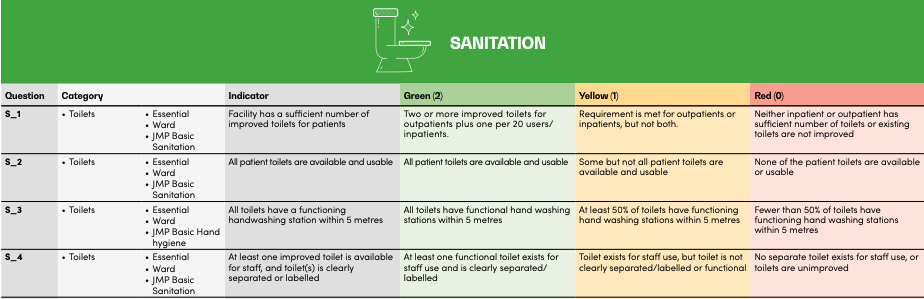
WASH FIT and Ukrainian context
In the Ukrainian context, the Energy and Environment domain appears to be an outlier compared with the other domains
The first six indicators in this domain repeatedly ask about one major thing: “Are you getting enough energy to sustain a service delivery?“, which was a priority #1 for every program of Health System Strengthening during the first two years of this protracted crisis.
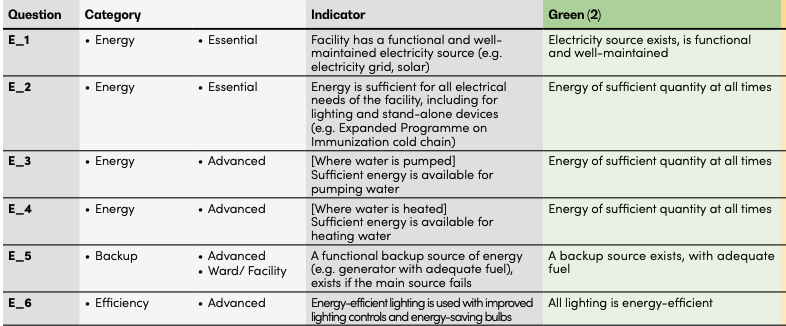
The next seven, although important, are not really relevant to the Ukrainian context, with the obvious exception of the ventilation indicator and the one assessing light in the delivery rooms. According to our expirience, the light in the delivery room depends on the presence of the reserve power source.
But the problem is not what these indicators in this domain ask about, but what they leave out. The thermal insulation envelope of health facilities is absent from the framework, despite being a key factor in maintaining indoor thermal comfort.
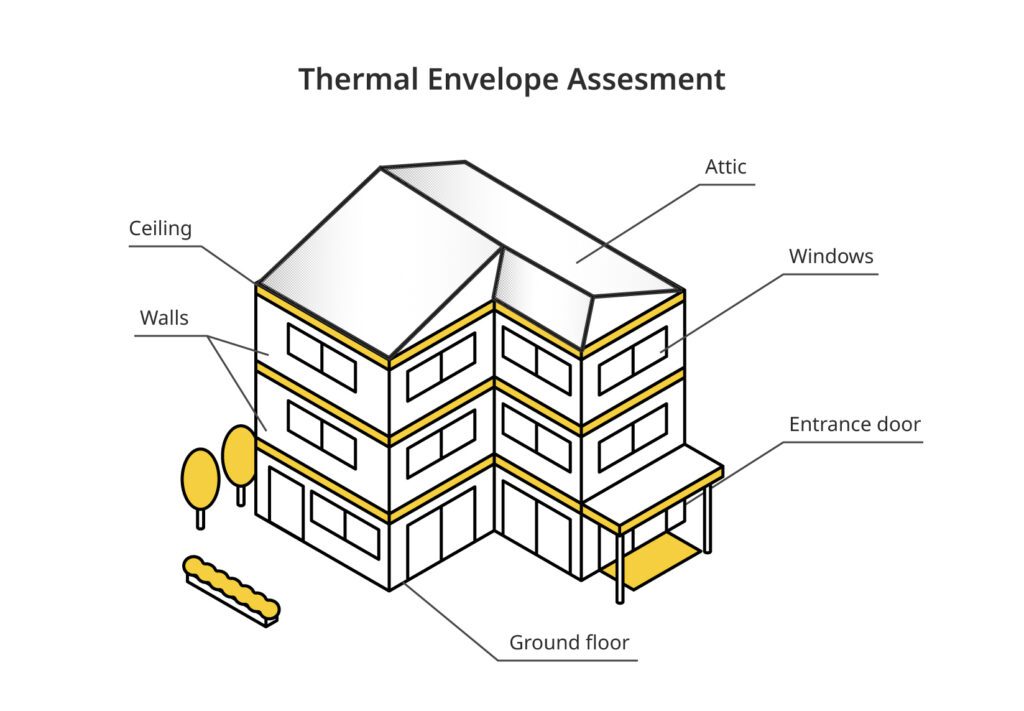
Thermal Comfort and Thermal Envelope
Numerous studies have shown that the indoor temperature below 18 °C is associated with negative health effects. Lack of thermal comfort might increase the number of days stayed in the hospital, and can impact the quality of healthcare delivery.
Some researchers argue that thermal comfort can foster the healing process of patients in hospitals, and one study from the School of Civil Engineering in Leeds considers it a life and death issue.
There are several contributing factors to thermal comfort, such as indoor temperature, humidity, ventilation, etc.
Most of the experts concluded that indoor temperature is the major determinant. Jonas Alex, in his textbook “Cold exposure and thermal
Comfort among patients in prehospital emergency care” defines temperature as a main predicament to the thermally comfortable environment:
Humans can only be in the thermal comfort zone when heat production and heat loss are in balance (Kingma et al., 2012). In a thermally comfortable environment, no cold or heat should be experienced.
In the Ukrainian context, thermal comfort in health facilities can be defined by several factors:
- Heat production – currently is not a part of the WASH FIT assessment.
- Heat loss – assessment of the thermal insulation / thermal envelope. Not a part of the WASH FIT.
- Ventilation – assessed by the WASH FIT.
Why the Thermal Envelope Assessment is not a part of the WASH FIT
Most countries where WASH FIT was originally applied intensively sit between 30° and -30° latitude.
WASH FIT Countries by Latitude Distribution
In those regions:
- heating is rarely a survival issue,
- buildings aren’t designed for extreme winter,
- Seasonal cold doesn’t dominate infrastructure risk.
But that’s not the case for countries like Ukraine, Kazakhstan, Tajikistan, and Lesotho, where the low average dips sub zero.
In the table below, among all countries where WASH FIT has been implemented, those located north of 30° or south of –30° latitude may face winter-related challenges in maintaining thermal comfort in hospitals and outpatient facilities, which can in turn increase the risk of certain infections.
| Country | Coldest Month | Avg Temp (°C) | Southern Latitude (NH) / Northern Latitude (SH) |
|---|---|---|---|
| Kazakhstan ❄️ | January | -10 to -5 | 40.6 |
| Tajikistan ❄️ | January | -2 to 0 | 36.7 |
| Ukraine ❄️ | January | -4 to -1 | 44.4 |
| Lesotho ❄️ | June-July | 0-3 | -30.7 |
| Bhutan | January | 4 to 8 | 26.7 |
| Syrian Arab Republic ❄️ | January | 6 to 8 | 32.3 |
| Jordan | January | 8 to 10 | 29.2 |
| Peru | June-August | 8 to 20 | -18.4 |
| Iraq | January | 9 to 11 | 29.1 |
| South Africa ❄️ | June-July | 10-12 | -34.8 |
| Pakistan | January | 10-12 | 23.7 |
| Nepal | January | 10-12 | 26.3 |
| Tunisia ❄️ | January | 10-12 | 30.2 |
| Lebanon ❄️ | January-February | 10-12 | 33.1 |
| occupied Palestinian territory ❄️ | January | 11-13 | 31.2 |
| Eswatini | June-July | 12-14 | -27.3 |
| Ecuador | June-August | 12-26 | -5 |
| Namibia | June-July | 13-15 | -28.6 |
| Zimbabwe | June-July | 13-15 | -22.4 |
| Egypt | January | 13-15 | 22 |
| Madagascar | July | 13-16 | -25.6 |
| India | January | 14-16 | 8.1 |
| Malawi | June-July | 14-17 | -17.1 |
| Bahrain | January | 14-17 | 25.5 |
| Zambia | June-July | 15-17 | -18.1 |
| Rwanda | June-July | 15-17 | -2.8 |
| Saudi Arabia | January | 15-17 | 16.4 |
| Ethiopia | November-December | 15-18 | 3.4 |
| Kenya | July-August | 16-18 | -4.7 |
| Venezuela | December-January | 16-27 | 0.6 |
| United Republic of Tanzania | June-July | 17-19 | -11.7 |
| Qatar | January | 17-19 | 24.5 |
| Viet Nam | January | 17-20 | 8.6 |
| Bangladesh | January | 18-19 | 20.7 |
| Mozambique | June-July | 18-20 | -26.9 |
| Angola | June-July | 18-20 | -18 |
| Uganda | June-July | 20-22 | -1.5 |
| Lao PDR | December-January | 20-22 | 13.9 |
| Chad | December-January | 20-23 | 7.4 |
| Sudan | January | 20-23 | 8.7 |
| Myanmar | December-January | 20-23 | 9.8 |
| Niger | January | 20-23 | 11.7 |
| DRC | July | 21-23 | -13.5 |
| Fiji | July-August | 22-23 | -20.7 |
| Vanuatu | July-August | 22-23 | -20.2 |
| Mali | January | 22-24 | 10.2 |
| Belize | January | 22-24 | 15.9 |
| Haiti | January-February | 22-24 | 18 |
| Comoros | July-August | 23-24 | -12.4 |
| Gambia | January | 23-24 | 13.1 |
| Papua New Guinea | July | 23-25 | -11.7 |
| Djibouti | December-January | 23-25 | 10.9 |
| Liberia | August | 24-25 | 4.4 |
| Ghana | August | 24-25 | 4.7 |
| Togo | August | 24-25 | 6.1 |
| Benin | August | 24-25 | 6.2 |
| Sierra Leone | August | 24-25 | 7 |
| Guinea | August | 24-25 | 7.2 |
| Guinea-Bissau | January | 24-25 | 11 |
| Jamaica | January-February | 24-25 | 17.7 |
| Somalia | July-August | 24-26 | -1.7 |
| Nigeria | August | 24-26 | 4.3 |
| Burkina Faso | January | 24-26 | 9.4 |
| Cambodia | January | 24-26 | 10.4 |
| Indonesia | July-August | 25-26 | -11 |
| Philippines | January | 25-26 | 4.6 |
| Sri Lanka | December-January | 25-27 | 5.9 |
| Maldives | December-January | 26-27 | -0.7 |
WASH FIT was implemented in the warm climate
The chart below summarizes the table and shows that only nine countries have an average temperature in the coldest month below 10°C, while in nearly 60 countries it remains above that level.
Countries by Coldest Temperature
If we group countries by their geographic position and look at where colder winters occur, a clear pattern emerges. Countries located outside the ±30-degree latitude band are far more likely to experience cold winters. In fact, 5 out of the 9 countries in this group have noticeably colder conditions during the coldest month.
The picture is completely different for countries located between 30° North and 30° South. Here, the pattern flips. Only 4 out of 59 countries — less than 10% — experience colder winters in this zone.
Cold Countries Beyond ±30° Latitude
Cold Countries Between 30°N and 30°S
Integrating the Therma Envelope Assessment Checklist into the official WASH FIT tool
So our team put together a Thermal Envelope Assessment checklist that includes heat loss by the building and heat production by the heating system — everything from visually inspecting windows, doors, walls, ceilings, and attics to looking at how well a facility actually holds heat during winter.
In our view, these assessments are especially relevant for countries outside the ±30° latitude zone or where the average temperature of the coldest month drops below 10°C.
The idea is simple: this checklist and its indicators can be easily integrated into the official WASH FIT tool, specifically under the Energy and Environment domain, to make it more realistic for cold-climate settings.
Leave a Reply