
In today’s article, I want to present the team’s effort of developing a tool for the assessment of the infrastructure of institutions (health and educational facilities, boarding houses, village clubs, etc.) for core principles and norms of universal design and inclusivity.
- The Global Movement Toward Universal Design
- The Evolution of Accessibility Standards
- Ukraine's Commitment to Inclusive Design
- Core Principles Underlying the Assessment Tools
- Tool 1: The Binary Assessment Tool
- Tool 2: The Automation-Based Assessment Tool
- Tool 3: The Humanitarian-Focused Assessment Tool
- Tool 4: The Evidence-Based Comprehensive Assessment Tool
- Choosing the Right Tool for Your Context
- Moving Forward: From Assessment to Inclusion
The Global Movement Toward Universal Design
In 2007, the United Nations ratified a convention that would become a watershed moment in the global disability rights movement. On a single day, 82 countries signed the Convention on the Rights of Persons with Disabilities, setting a record for the highest number of signatories on an opening day for any UN convention.
This landmark treaty became the fastest-negotiated human rights convention in UN history, reflecting unprecedented international consensus on disability rights. On July 30, 2009, the US became the 142nd country to sign, followed by Monaco on September 23 as the 143rd signatory. Today, three-fourths of countries worldwide have signed this transformative convention, marking a fundamental shift in how societies understand and address disability.
Ukraine was one of the first countries to sign and ratify this convention.
Over the past half-century, the concept of disability has undergone a dramatic transformation. Universal design and inclusive design have evolved substantially, both as legislative frameworks and as practical design concepts.

This evolution began for many countries with the realization of their aging populations. Advances in medicine meant that people who previously would have died from various conditions were now surviving and participating in society. Additionally, returning veterans from conflicts, including World War II and the Korean War, brought the needs of people with disabilities into sharp focus, catalyzing significant changes in civil rights movements.
Currently, Ukraine is facing both a mounting number of victims of war and an ageing population, so developing an inclusive environment is critical on both community, institutional, and political levels.
The Evolution of Accessibility Standards
The accessibility movement in the United States gained particular momentum in the realm of education. The landmark 1954 Brown v. Board of Education case established the principle that “separate is not equal,” initially applied to racial segregation but later extended to broader inclusion concepts.
By 1961, the US had developed the first specifications for making buildings and facilities accessible for people with handicaps, published by ANSI (American National Standards Institute). The Civil Rights Act of 1964 represented another landmark achievement, responding to demands from civil society movements during a period of rapid economic growth.

The Minimum Guidelines and Requirements for Accessible Design were published in 1981, followed by the Americans with Disabilities Act (ADA) guidelines in 1991, which remain one of the primary prescriptive frameworks in the United States today. These developments reflected a growing understanding that accessibility was not merely a matter of accommodation but a fundamental right.
Ukraine’s Commitment to Inclusive Design
Ukraine was among the signatories of the UN Convention on the Rights of Persons with Disabilities, demonstrating its commitment to international standards of accessibility and inclusion. The most prescriptive concepts of universal design were incorporated into Ukraine’s DBN (Derzhavni Budivelni Normy), or state construction norms. The latest revision of these norms occurred in 2018, with a strong focus on inclusive design principles.
Building on this legislative foundation, our team developed four comprehensive tools to assess the accessibility and universality of infrastructure integration in Ukrainian institutions. The development process involved dividing our team into four groups, each bringing expertise in engineering and humanitarian design principles.
All team members had at least two years of experience working in international organizations and had been implementing WASH (Water, Sanitation, and Hygiene) programs for two years, ensuring they possessed the practical experience necessary for this work.
Core Principles Underlying the Assessment Tools
All four assessment tools share a fundamental approach centered on the user journey. Our primary persona is a person with restrictive mobility, which includes:
- wheelchair users,
- parents with small babies,
- elderly,
- people with temporary disabilities (after surgery, injury, etc.),
- those using other assistive devices (walkers, crutches, etc.).

Each assessment tool visualizes and models the complete user experience, from entering the facility compound to using washrooms, elevators, and physicians’ offices.
This comprehensive approach ensures that no aspect of accessibility is overlooked.
The foundation of these tools rests on core principles of Design for All (DfA), which state that products and services must be:
- Demonstrably suitable for most potential users without any modifications.
- Easily adaptable to different users through adaptable or customizable interfaces.
- Capable of being accessed by specialized user interaction devices and assistive technologies.
- Developed with the involvement of potential users in all phases of development.
Tool 1: The Binary Assessment Tool
The first tool in our suite is the Binary Assessment Tool, designed by Igor Onyshchenko and tested by Olga Shtepa in one of Ukraine’s clinics. This tool features 64 yes/no questions, making it straightforward and user-friendly with a minimal learning curve required.

During field testing, the team successfully assessed a clinic and determined it was 92% ready in terms of accessibility compliance. The
Binary Tool’s strength lies in its simplicity and clarity. Each question can be answered definitively, allowing for quick assessments that provide a clear percentage-based understanding of an institution’s accessibility status.
This tool is ideal for organizations conducting initial accessibility audits or for teams without extensive technical expertise in accessibility standards. Its straightforward approach removes ambiguity and enables rapid deployment in field conditions.
Tool 2: The Automation-Based Assessment Tool
The second tool represents a more sophisticated approach, incorporating software automation to streamline the assessment process. This tool is designed to reflect the model of the WASH FIT (Water and Sanitation for Health Facility Improvement Tool) assessment framework, using a three-point scale of 0, 1, and 2 to evaluate accessibility features.

With over 25 questions for comprehensive assessment across all categories outlined for the assessment tools, this instrument requires more experience to use effectively. However, it offers significant advantages in return for this complexity. The tool utilizes elaborate Excel formulas to automatically calculate scores, reducing manual computation errors and saving time. Notably, it includes an integrated slope calculator, which proves invaluable for rapidly evaluating ramp compliance with accessibility standards.
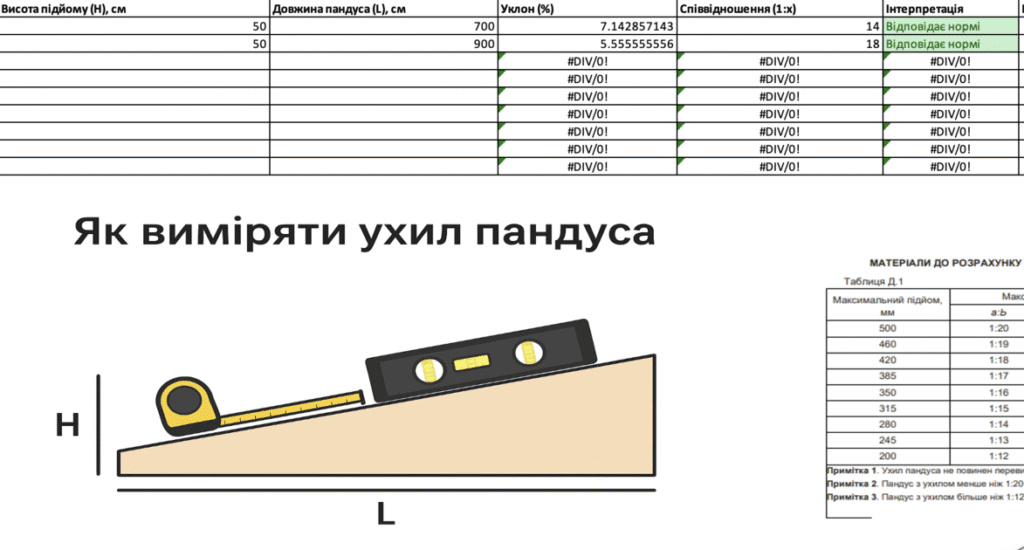
This automation-based tool is extremely powerful but requires users who can interpret Ukraine’s state construction norms and make nuanced judgments about partial compliance.
It is designed for people with previous expirience in inclusive design. The tool’s open-ended nature allows for more detailed evaluation of complex situations, though this same flexibility demands greater expertise to use accurately. Designed by Dmytro Meroniuk and tested by Roman Kolos, this tool represents a significant advancement in balancing comprehensiveness with usability.
Tool 3: The Humanitarian-Focused Assessment Tool
The third tool may be the most strategically valuable for humanitarian organizations operating in crisis contexts, as it not only assesses accessibility but prioritizes interventions based on criticality. This tool employs a four-point scale: fully implemented, partially implemented, not implemented, and not applicable. What distinguishes this tool is its integration of criticality categorization for each indicator.

The assessment framework assumes three levels of criticality:
- completely critical (marked in red),
- intermediate priority,
- lower priority (green)
Based on these categorizations, different scores are assigned, creating a weighted assessment that reflects real-world impact on users. An experienced assessor can use this tool to design immediate humanitarian implementation plans, creating a matrix of interventions prioritized by criticality.
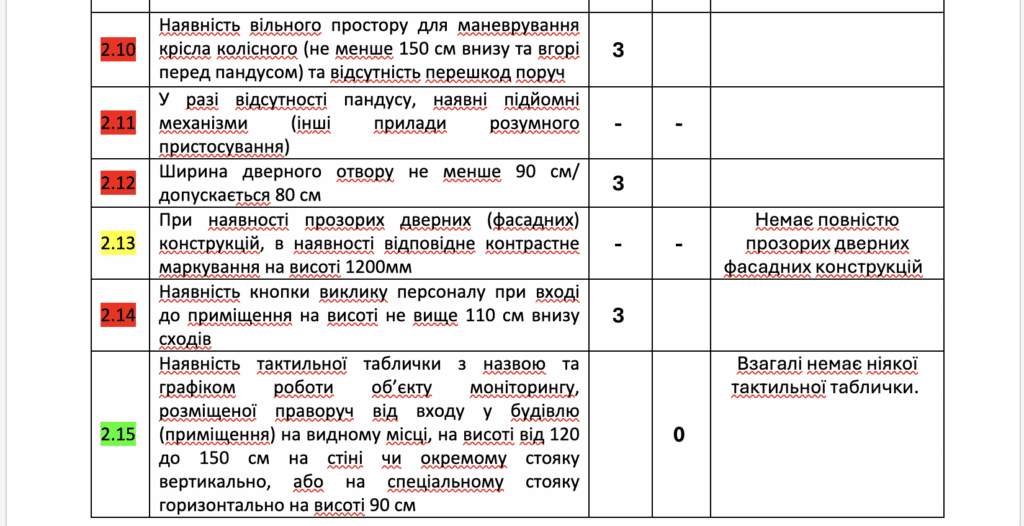
This approach offers the shortest lead time from assessment to intervention, making it particularly valuable for humanitarian actors who must make rapid decisions about resource allocation. The tool clearly identifies the most critical gaps, explains why these gaps present the greatest barriers to accessibility, and generates actionable results. For organizations working in emergency or resource-constrained environments, this prioritization function is invaluable.
Designed by Yurii Usenko and tested by Tetiana Klymenchuk, this humanitarian-focused tool bridges the gap between assessment and action.
Tool 4: The Evidence-Based Comprehensive Assessment Tool
The fourth and final tool represents the most structured and scientifically rigorous approach in our suite of inclusive assessment instruments. Designed by Nadia Marchenko and tested by rehab specialist Andrii Gavrylenko, this tool was built on the foundation of previous research and tool development experiences, truly standing on the shoulders of giants in the accessibility assessment field.

This tool is exceptionally well-designed, well-structured, and scientifically approached. It incorporates safety indicators, reflecting the expertise of one of Ukraine’s strongest infection prevention and control (IPC) specialists and epidemiologists. The tool is beginner-friendly while remaining comprehensive and structured, making it accessible to newer practitioners while providing the depth required for thorough assessment.
What makes this tool particularly valuable is its evidence-based nature. It incorporates previous experiences in developing similar assessment instruments, grounding its methodology in tested approaches.
The tool is built primarily around Ukraine’s DBN state construction norms but also integrates sanitary norms and infection prevention and control protocols, creating an innovative intersection of accessibility and health safety standards.
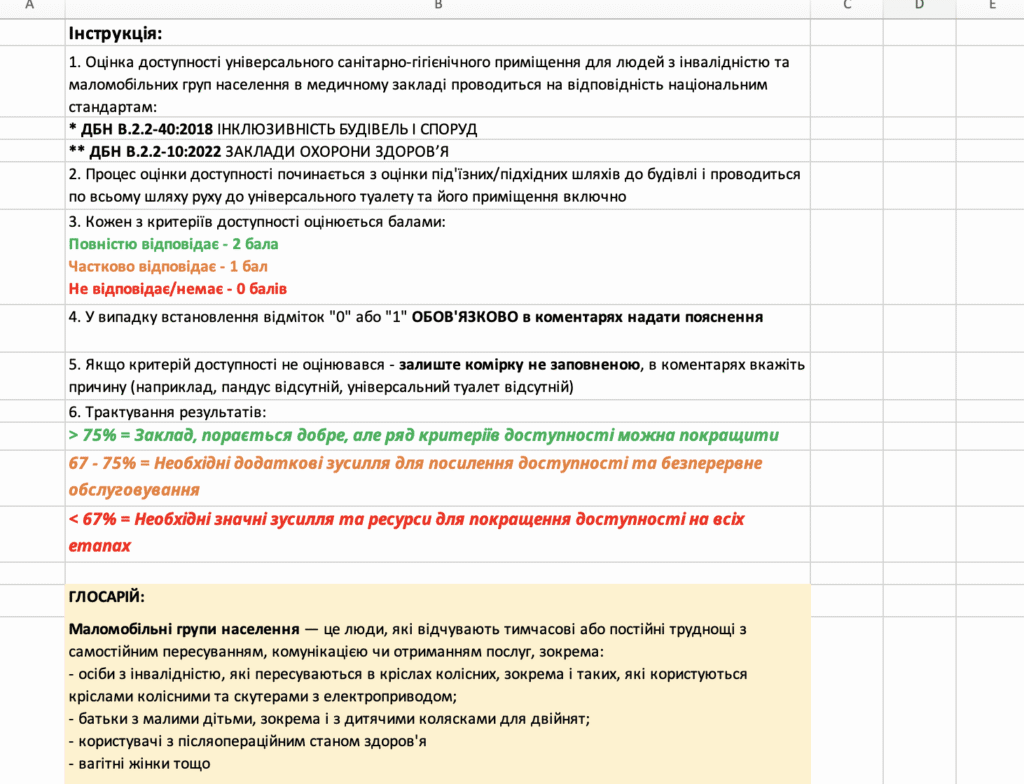
This represents one of the most scientifically proven and evidence-based assessment scales in our collection. It is the ideal choice for organizations seeking a reliable tool built on previous research experiences in Ukraine, for those who need an instrument that has been validated through prior implementations and assessments, and for practitioners who want assurance that their assessment methodology is grounded in established best practices.
Choosing the Right Tool for Your Context
Each of these four tools serves distinct purposes and suits different organizational needs and contexts. The Binary Tool offers simplicity and speed for quick assessments. The Automation-Based Tool provides depth and computational power for experienced assessors. The Humanitarian-Focused Tool prioritizes action through criticality weighting, perfect for emergency contexts. The Evidence-Based Comprehensive Tool offers scientific rigor and validation for organizations requiring documented methodologies.
Together, these tools represent Ukraine’s commitment to implementing the principles of the UN Convention on the Rights of Persons with Disabilities in practical, contextualized ways. They reflect an understanding that accessibility is not a one-size-fits-all proposition but rather requires flexible approaches that can adapt to different institutional contexts, organizational capacities, and urgency levels.
Moving Forward: From Assessment to Inclusion
As Ukraine continues to align its infrastructure with international accessibility standards, these assessment tools provide essential mechanisms for measuring progress and identifying gaps. They transform abstract principles of universal design into concrete, measurable criteria that can guide institutional improvements.
The development of these tools reflects a broader understanding that true inclusion requires not just good intentions but systematic approaches to identifying and addressing barriers. By providing multiple pathways for assessment—from simple binary evaluations to complex, evidence-based frameworks—we ensure that organizations at various stages of accessibility maturity can engage meaningfully with the challenge of creating truly inclusive institutions.
The journey toward universal accessibility is ongoing, and these tools represent important milestones in that journey for Ukraine. As we continue to learn from implementation experiences and international best practices, these instruments will evolve, incorporating new insights and adapting to changing contexts. What remains constant is the commitment to ensuring that all individuals, regardless of their abilities, can access and participate fully in institutional life—a commitment enshrined in international law and increasingly embedded in Ukrainian practice.
Leave a Reply